
At a Glance
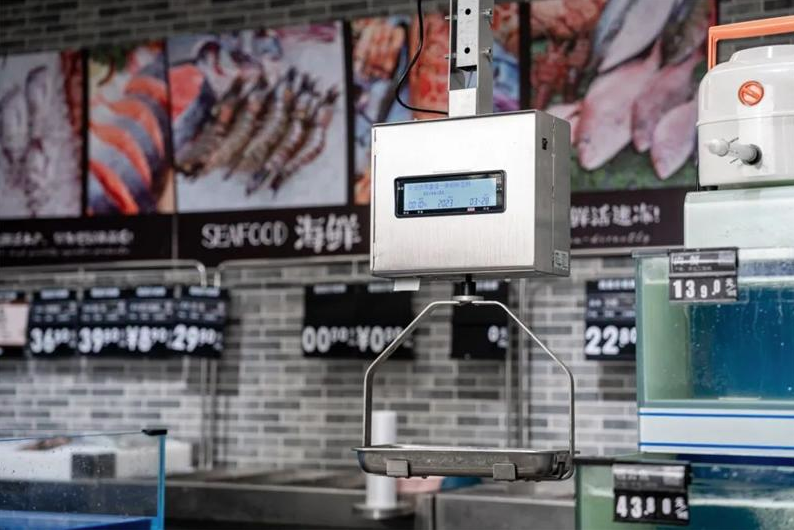
A hanging label printing scale is a commercial weighing system with a built-in thermal label printer, installed overhead. It is mainly used at supermarket seafood counters, meat departments, butcher shops, and other fresh-food retail areas. Because the scale is suspended above the counter, it frees up valuable workspace and reduces direct exposure to standing water and spills.
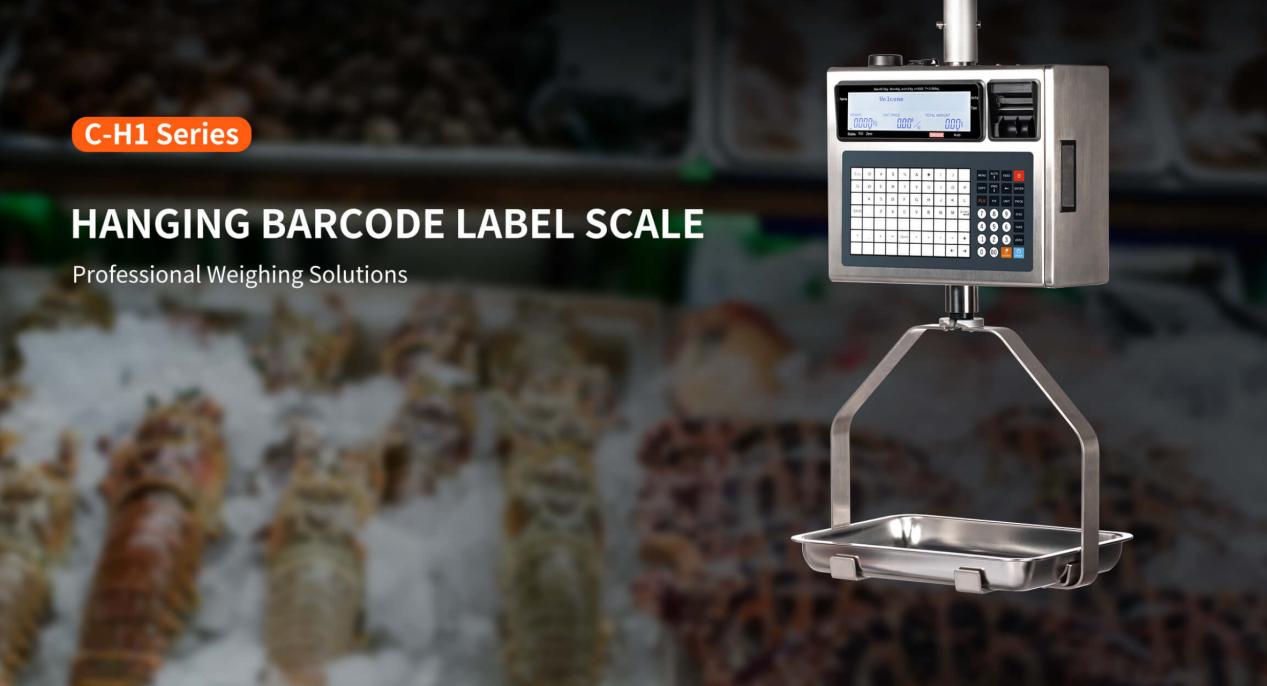
The HPRT C-H1 hanging scale with label printer is suitable for fresh-food retail environments. It features an anti-swing design, dual-sided displays, a water- and insect-resistant structure, and support for linerless label printing. It is suitable for seafood counters, butcher shops, meat markets, wet markets, and similar retail environments.
What Is a Hanging Label Printing Scale, and How Is It Different from a Countertop Label Scale?
A hanging label printing scale is a commercial weighing and labeling device that is suspended from the ceiling instead of sitting on the countertop.
It combines a weighing sensor, thermal printing module, and PLU product management system. After weighing an item, the scale can print a label containing information such as the barcode, product name, unit price, weight, and total price.
This type of scale is widely used in fresh-food retail operations where both weighing and product labeling are required.
Hanging Label Printing Scale vs. Countertop Label Printing Scale
Two common types of retail barcode label scales are countertop models and hanging models. One occupies counter space, while the other is suspended above the work area. Their ideal operating environments are also different.
|
Comparison |
Hanging Label Printing Scale |
Countertop Label Printing Scale |
|
Installation |
Suspended installation above the counter; does not occupy countertop space |
Placed directly on the counter |
|
Best suited for |
Seafood counters, meat departments, and work areas with limited space or frequent splashing |
Dry, organized fresh-food counters and produce sections |
|
Space advantage |
Frees up the work surface for seafood preparation, meat handling, and packaging |
Requires dedicated counter space |
|
Maintenance environment |
Suspended housing reduces direct exposure to standing water and contaminated liquids |
Water and spills on the counter may increase the risk of liquid entering the scale |
In short: choose a hanging scale when counter space is limited or the environment is frequently wet. Choose a countertop scale when the work area is dry and has enough space.
Where Are Hanging Label Printing Scales Commonly Used?
1. Supermarket Seafood and Fish Counters
Seafood departments frequently deal with splashing water, ice, and limited counter space. A hanging scale keeps the weighing equipment above the main work surface, leaving more room for handling fish, shrimp, shellfish, and other seafood.
After weighing, the scale can immediately print a barcode label for the product.
2. Meat and Deli Counters
Fresh meat and deli preparation areas often have limited workspace.
A hanging meat scale can help keep the counter clear for cutting, portioning, wrapping, and packing products. A dual-sided display also allows both the operator and the customer to view weight and price information.
Compared with a conventional countertop butcher scale, a hanging model is especially useful when you need to free up as much counter space as possible.
3. Wet Markets, Seafood Shops, and Butcher Shops
Traditional market stalls are often compact, and the work surface may be exposed to water, blood, food residue, and other contaminants.
A countertop scale can be more vulnerable to direct contact with these liquids. Hanging installation helps reduce the risk of the scale housing being exposed to standing water on the counter.
4. Fresh Prepared Foods and Pre-Pack Operations
Stores that portion prepared foods, cleaned vegetables, or fresh meat can use a hanging scale with a label printer to weigh items and print barcode labels on the spot. The packaged product can then be scanned at the POS checkout.
6 Key Factors to Consider When Choosing a Hanging Label Printing Scale
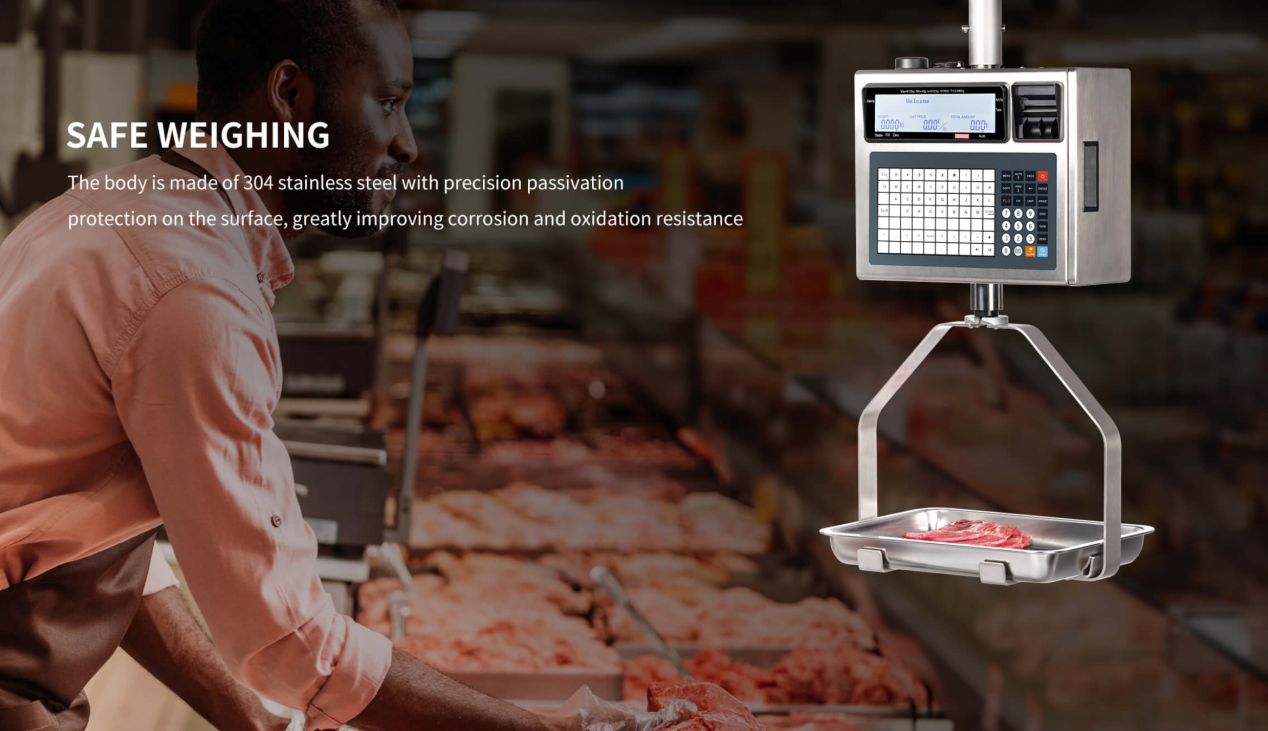
Price alone should not determine which hanging scale you buy. For seafood, meat, and fresh-food retailers, the following six factors have a much greater impact on daily operation.
1. Weighing Performance: Capacity, Division and Anti-Swing Stability
Common challenge: when fish or other products are placed on a suspended weighing pan, the pan may continue to swing. Conventional hanging scales often take longer to stabilize, slowing service during peak hours.
What to look for: choose a model with an effective anti-swing design that helps stabilize the weighing pan quickly.
For seafood and fresh meat applications, capacities of 6 kg or 15 kg with divisions of 2 g or 5 g can cover a range of products from smaller portions to larger fish and meat cuts.
2. Housing Protection and Pan Material: Water Resistance, Insect Protection and 304 Stainless Steel
Common challenge: seafood departments are exposed to high humidity, splashing water, food residue, and insects. If the scale housing is not sufficiently protected, moisture or contaminants may enter the unit and increase the risk of component failure.
What to look for: the scale should be designed to keep out splashing water, dirt, and insects.
For surfaces that come into direct contact with food, a 304 food-grade stainless steel weighing pan is preferable because it is corrosion-resistant, easy to clean, and suitable for fresh-food handling environments.
3. Printing Capability: Resolution and Supported Media
Common challenge: some older label scales only support conventional labels with backing liner. This limits media choices and can increase waste in high-volume printing environments.
What to look for: a 203 dpi direct thermal printer is sufficient for common retail barcode and product labels and does not require ink or ribbon.
A versatile retail scale should support multiple types of media, such as:
• Direct thermal labels
• Linerless labels
• Thermal receipt paper
• Black-mark media
For high-volume retail environments, linerless label printing reduces backing-paper waste and cuts down on media changes.
4. Display and Operator Interface: Dual-Sided Display and Hot Keys
Common challenge: if only the operator can see the display, customers cannot directly verify the weight, unit price, and total amount. In addition, too few PLU shortcut keys can slow product selection during busy periods.
What to look for: a dual-sided display is particularly useful at seafood, meat, and deli counters because both the operator and the customer can view transaction information.
The C-H1 hanging barcode label scale provides 70 hot keys and 28 function keys, allowing commonly sold products to be retrieved quickly.
5. Connectivity: Ethernet and Wi-Fi for POS and Scale Management
For networked retail operations, the scale should support Ethernet and/or Wi-Fi connectivity.
Network connectivity can be used for tasks such as:
• Distributing PLU product data
• Updating label templates
• Connecting with retail management systems
• Centrally managing multiple scales across stores
This is particularly useful for supermarket chains and other multi-store retail operations.
6. Paper Loading: Faster Media Replacement
Fresh-food retailers can consume large quantities of labels during a normal business day, making frequent roll changes unavoidable.
A simple paper-loading mechanism helps employees replace media quickly without complicated steps, reducing downtime during busy periods.
HPRT C-H1 Hanging Label Printing Scale for Seafood, Meat & Wet Markets
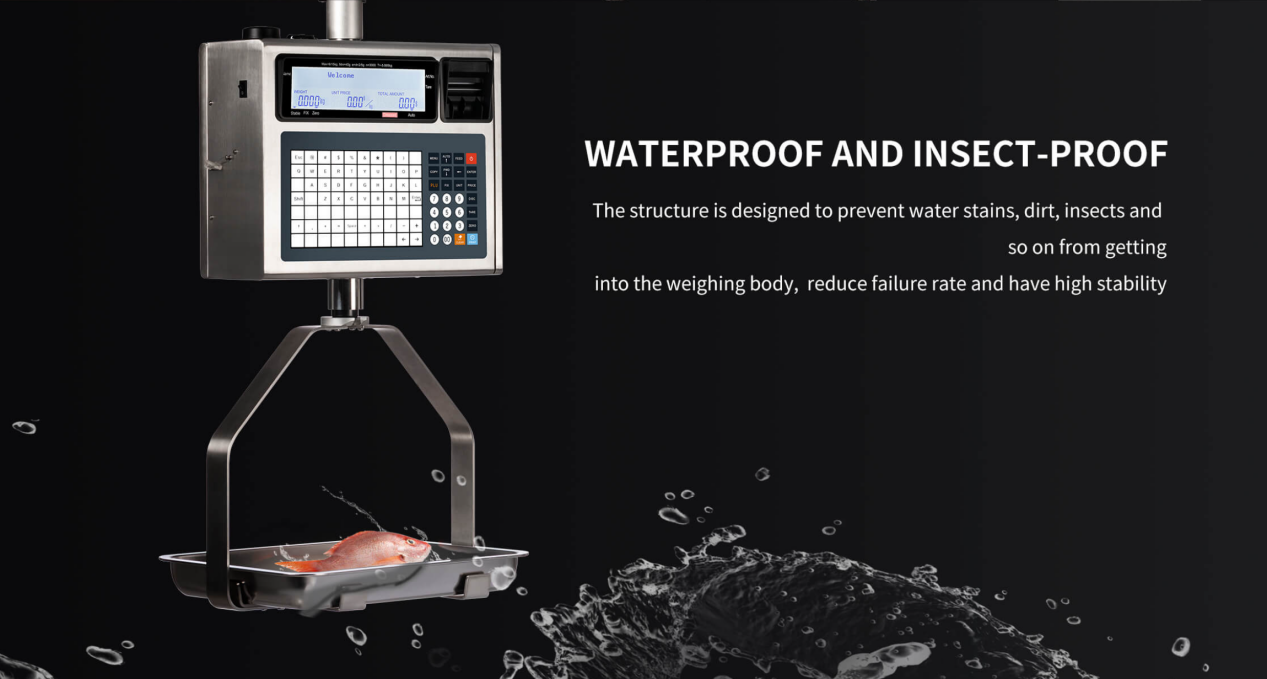
The C-H1 hanging label printing scale is designed to address common weighing and labeling challenges in seafood, fresh meat, deli, and other fresh-food retail environments. Its suspended installation keeps the scale off the countertop, making it ideal for wet or space-constrained work areas.
The C-H1 combines:
• Weighing
• Price computing
• Thermal label printing
• PLU product management
Ethernet is standard, while Wi-Fi is available as an option. The scale is suitable for supermarkets, wet markets, seafood shops, butcher shops, and other fresh-food retailers.
Key Features of the HPRT C-H1
✅️ Anti-swing design: helps stabilize the weighing pan quickly, reducing waiting time during busy service periods.
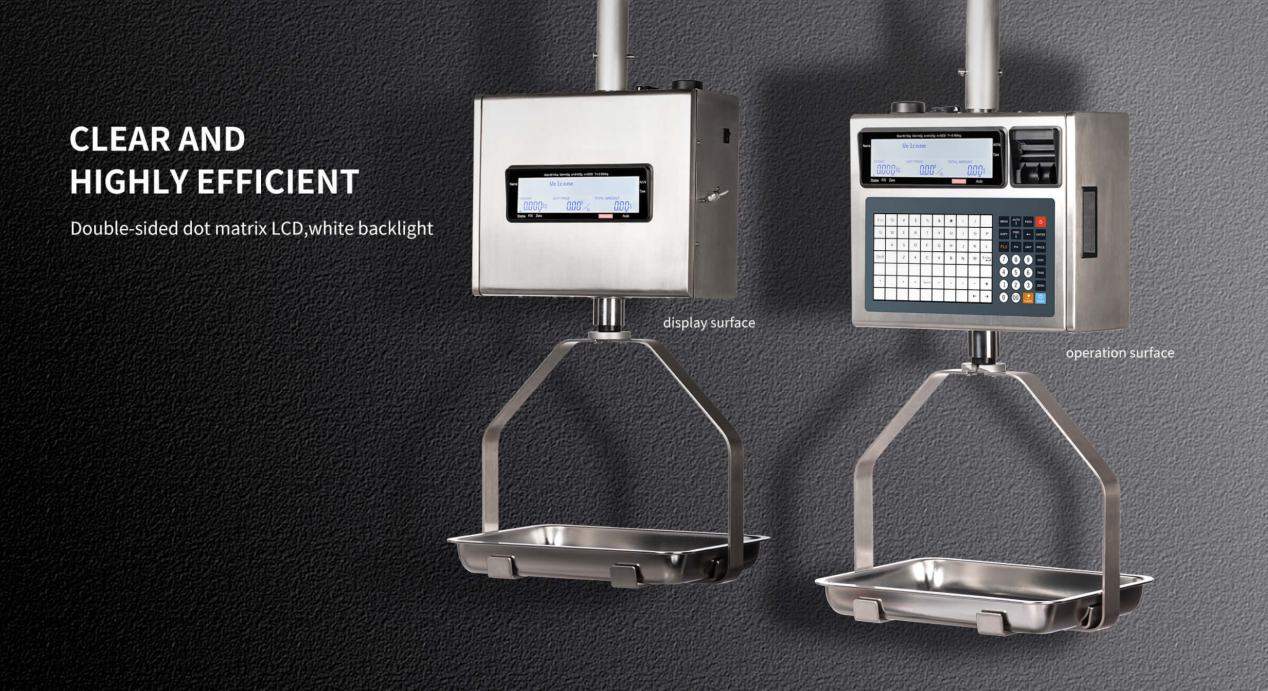
✅️ Dual-sided dot-matrix LCD with backlight: allows both the operator and customer to view weight and price information.
✅️ Easy paper-loading design: enables faster label roll replacement and simplifies routine operation.
✅️ Water- and insect-resistant structure: designed to help prevent splashing water, dirt, and insects from entering the scale housing.
✅️ Food-grade stainless steel weighing pan: suitable for contact with fresh foods, resistant to corrosion, and easy to wipe clean.
✅️ Multiple media options: supports thermal labels, linerless labels, and thermal receipt paper, with black-mark detection for compatible media.
✅️ 70 hot keys and 28 function keys: allows operators to access frequently sold products quickly.
✅️ Ethernet as standard with optional Wi-Fi: supports centralized configuration and PLU data management for multiple connected scales.
HPRT C-H1 Key Specifications
|
Item |
Specification |
|
Weighing capacity |
6 kg / 15 kg |
|
Division |
2 g / 5 g |
|
Print resolution |
203 dpi |
|
Maximum print width |
56 mm |
|
Supported label size |
30 × 30 mm to 60 × 120 mm |
|
Display |
Dual-sided dot-matrix LCD with backlight |
|
Communication |
Ethernet standard; optional Wi-Fi |
|
Weighing pan |
304 food-grade stainless steel |
|
Paper loading |
Easy-loading structure supporting linerless labels and black-mark media |
What Types of Stores Are Suitable for the HPRT C-H1?
The C-H1 is suitable for:
✔️ Supermarket seafood and fish counters
✔️ Fresh meat and deli departments
✔️ Seafood shops and butcher shops
✔️ Wet markets
✔️ Fresh prepared-food and pre-pack operations
✔️ Fresh-food retail chains requiring centralized PLU management across multiple scales
HPRT offers a range of commercial weighing solutions for retail environments, including label printing scales, AI vision scales, and POS scales. These product lines support different stages of the retail workflow, from fresh-food weighing and labeling to checkout and settlement.
Visit the official website or contact the sales team for product selection assistance and quotation information.
Hanging Label Printing Scale FAQ
1. Can a hanging label printing scale connect to a supermarket POS system?
The C-H1 is equipped with an Ethernet interface and supports optional Wi-Fi connectivity. It can work with compatible retail software for PLU data distribution and barcode label printing, making it suitable for fresh-food retail workflows.
2. What can I do if a hanging scale keeps swinging during weighing?
A suspended weighing pan may continue moving after a product is placed on it, which can increase the time required for the reading to stabilize.
The C-H1 uses an anti-swing design to help stabilize the pan more quickly, reducing weighing wait time during busy retail operations.
3. What is the weighing capacity of the C-H1, and is it suitable for seafood?
The C-H1 is available with 6 kg or 15 kg maximum capacity and 2 g or 5 g divisions.
It also features a 304 food-grade stainless steel weighing pan and a structure designed to resist splashing water and insects, making it well suited to seafood, fish, and fresh meat counters.
4. Is a hanging label printing scale difficult to install?
A hanging scale requires secure overhead mounting and is generally installed and commissioned by the equipment supplier or a qualified service provider.
Once installation is complete, the scale can be connected to the store network through Ethernet or Wi-Fi, depending on the configuration.
5. What label sizes does the C-H1 support?
The C-H1 supports label sizes from 30 × 30 mm to 60 × 120 mm, with a maximum print width of 56 mm.
It supports black-mark media and linerless labels.
6. Can multiple hanging scales share and manage PLU data remotely?
Yes. The C-H1 can be used with scale management tools to centrally configure and maintain PLU product data across multiple connected devices over the internet.
This makes it suitable for supermarket chains and fresh-food retailers operating multiple stores.