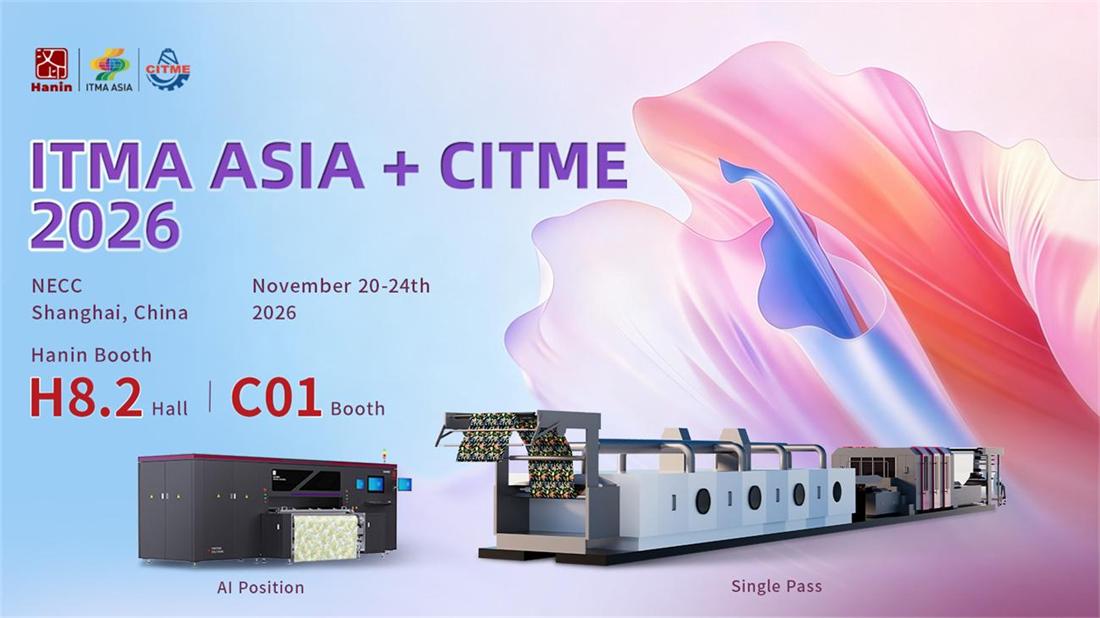
Hanin will unveil two new digital textile printers at ITMA ASIA + CITME 2026, taking place from 20 to 24 November at the National Exhibition and Convention Center (Shanghai).
The new Hanin Iris Series Positioning Digital Textile Printer and Apollo Series Single-Pass Multi-Process Digital Textile Printer address two distinct production requirements: precision positioning on premium fabrics and high-speed digital printing for medium- and high-volume orders.
Together, the two fabric printers demonstrate complementary capabilities: vision-guided positioning for premium fabrics, and high-speed single-pass printing with integrated hybrid processing for medium- and high-volume production.
Event: ITMA ASIA + CITME 2026
Date: 20–24 November 2026
Venue: National Exhibition and Convention Center (Shanghai)
Hanin Booth: Hall H8.2, Booth C01
What capabilities will these two new platforms bring to textile manufacturers? Here is an early look ahead of their official debut.
Iris Series: Precision Positioning for Premium Fabrics
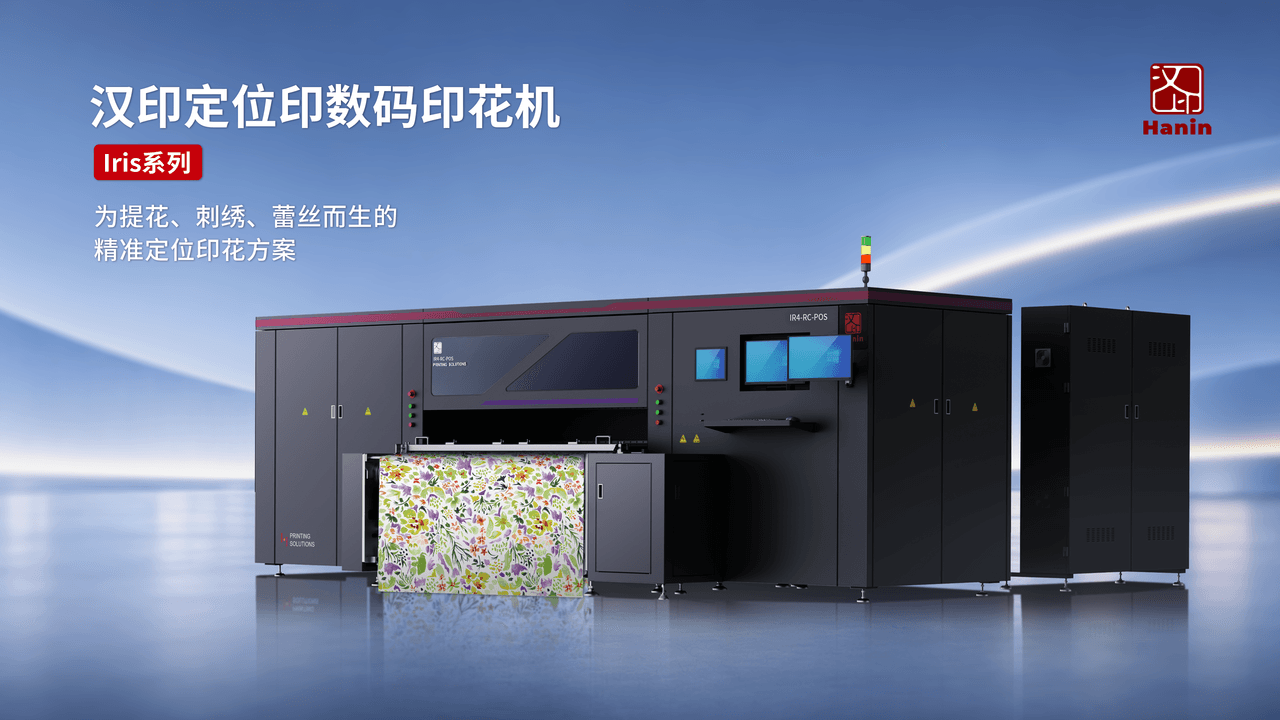
For manufacturers of premium womenswear, scarves, shawls, formalwear fabrics and designer textiles, one of the greatest production risks is not the absence of a suitable design. It is the possibility that inaccurate printing could compromise a high-value fabric.
This risk is particularly significant for detailed materials such as jacquard, embroidered fabric, lace and silk. If the printed design is misaligned, covers embroidery or gold and silver threads, or fails to match the woven edges, the value of an entire roll of fabric can be significantly reduced.
The Hanin Iris Series Positioning Digital Textile Printer is designed to address these challenges through accurate visual recognition and stable printing performance.
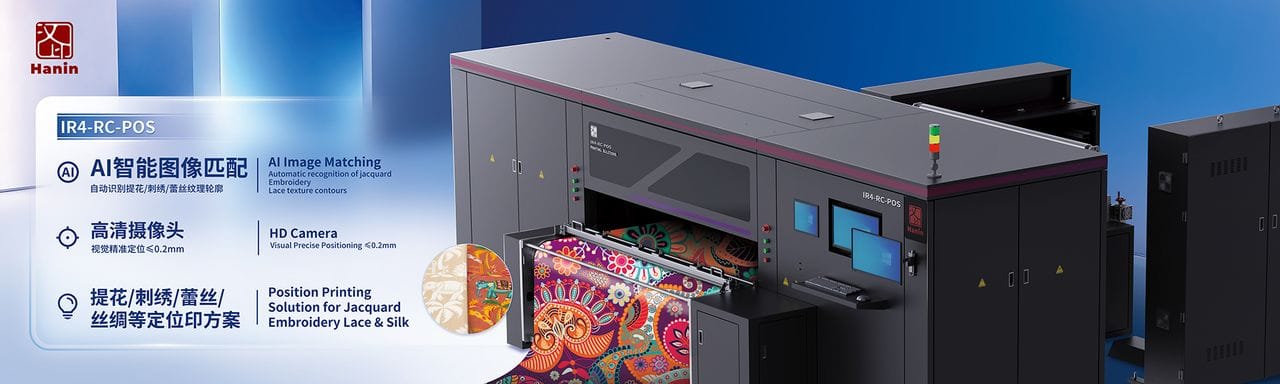
1. Vision-Based Positioning with ±1 mm Accuracy
The Iris series delivers vision-based positioning accuracy of ±1 mm. A high-definition camera works with AI-powered algorithms to automatically identify the contours and textures of jacquard, embroidery and lace.
This helps reduce three common problems in premium textile printing: misplaced patterns, designs covering embroidery or gold and silver threads, and misalignment with woven edges. Positioning printing can therefore move from reliance on operator experience to a more precise, vision-guided workflow.
2. Seamless Full-Width Printing for Short-Run Production
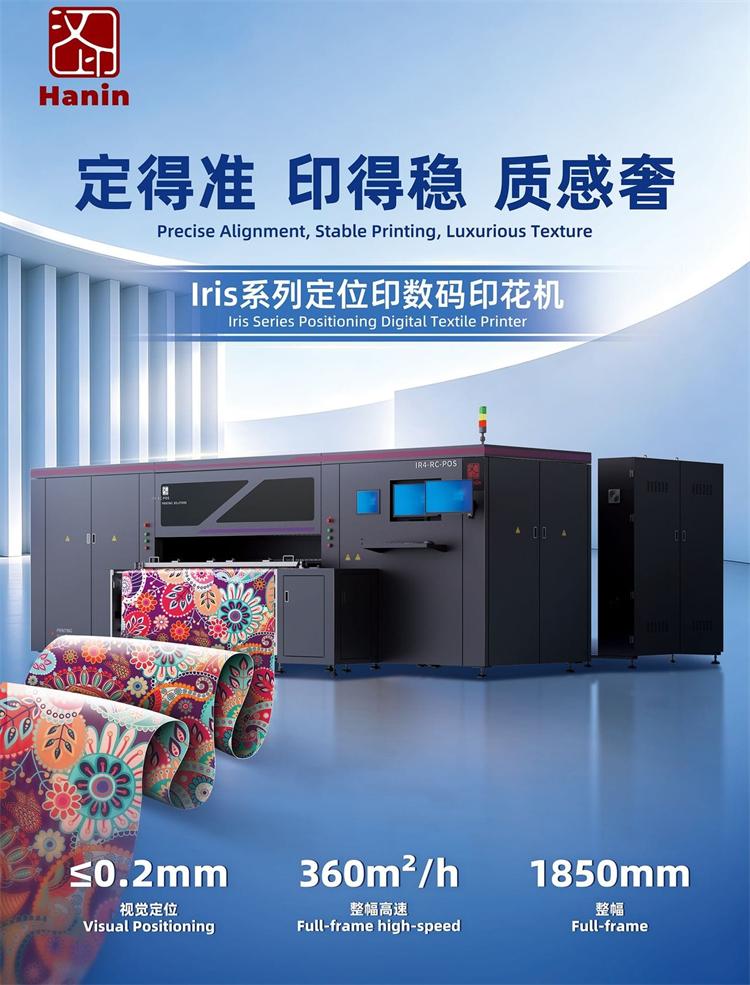
With output of up to 360 m²/h and a full printing width of 1,850 mm, the Iris series prints across the entire fabric width without image stitching. Its production capacity supports both responsive short runs and larger export orders.
Plate-free direct-to-fabric printing eliminates the plate-making stage, shortening the path from design file to finished output to a matter of days. This provides greater flexibility for fast-fashion collections, customized orders and designs requiring frequent changes.
3. Flexible Production Across Fabrics and Processes
One Iris system can support positioning printing on jacquard, embroidered fabric, lace, silk and other premium textiles.
It is also compatible with reactive, acid, pigment and high-temperature disperse printing processes, allowing manufacturers to handle a broader range of materials and applications with a single platform and improve equipment utilization.
By combining accurate positioning with high-definition output, the Iris series supports the realization of gradients, dimensional effects and designs incorporating gold and silver threads. It helps manufacturers scale premium positioning printing from small batches to larger production runs.
Apollo Series: Single-Pass Speed with Integrated Hybrid Processing
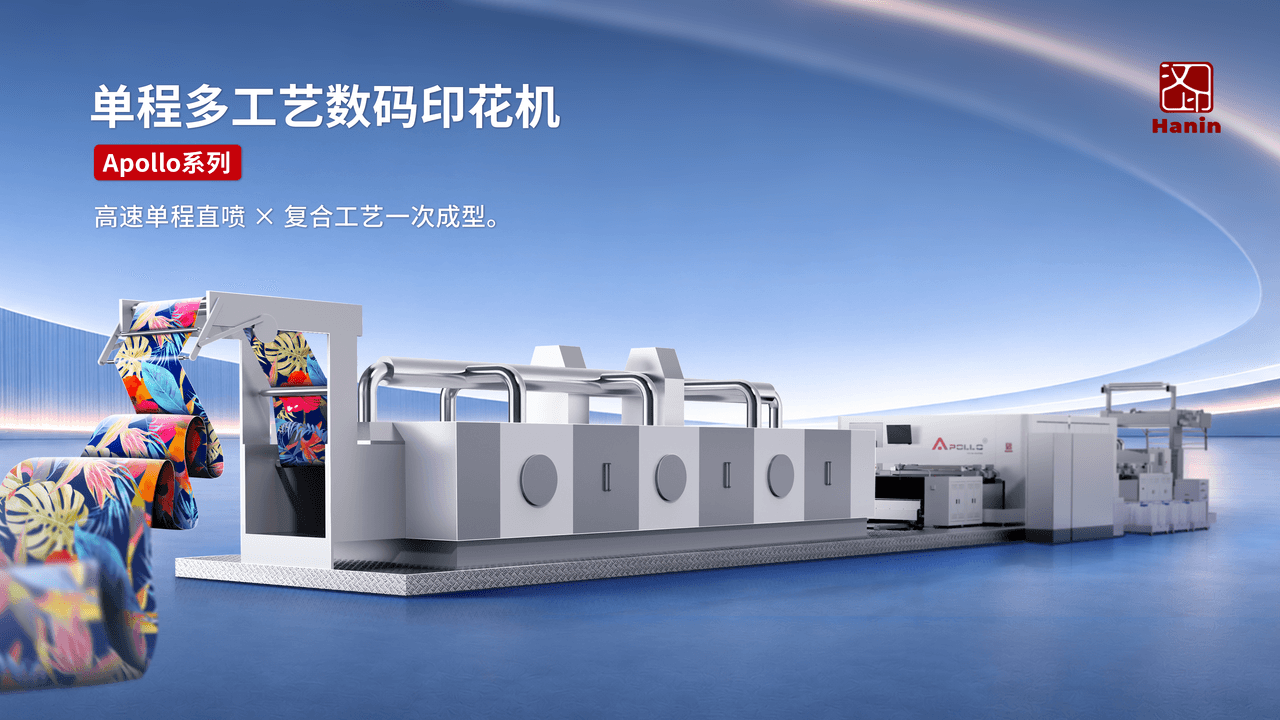
Making its debut at ITMA ASIA + CITME 2026, the Hanin Apollo Series Single-Pass Multi-Process Digital Textile Printer addresses a different set of production challenges.
Medium- and high-volume reactive and disperse printing operations, export-oriented textile processors, and manufacturers combining solid ground colors with special effects often face three constraints: existing rotary-screen lines operating at capacity, increasingly compressed lead times, and repeated machine passes to apply solid ground colors and special effects in register.
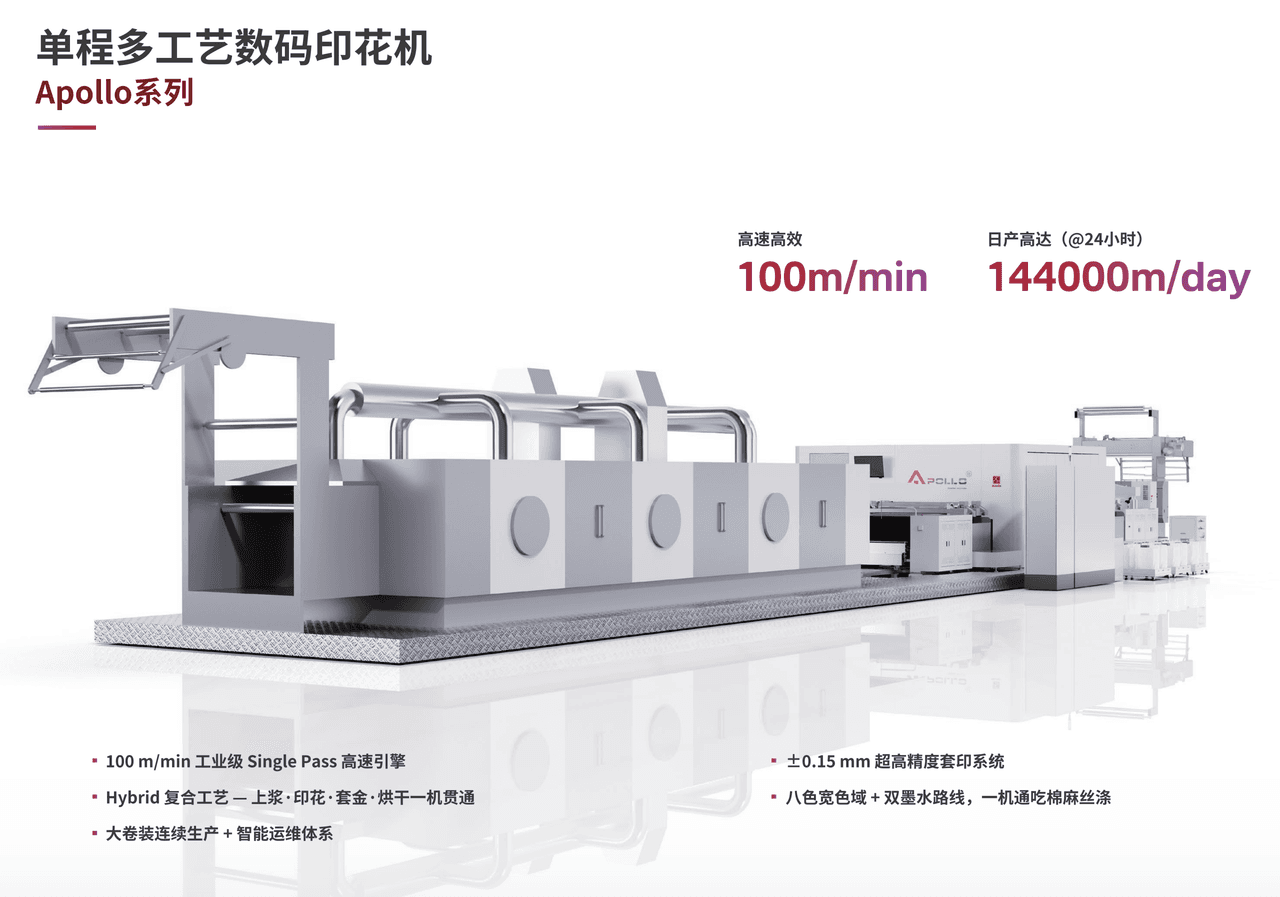
The Apollo series integrates a high-speed single-pass engine designed to compete with conventional rotary-screen production lines. It runs reliably at 100 m/min at 600 x 600 dpi and reaches speeds of up to 50 m/min at 600 x 1,200 dpi, balancing production speed with print resolution.
For export-oriented textile processors, this means digital direct-to-fabric printing can move beyond short-run supplementary production and become a primary option for larger-volume orders.
Integrated Hybrid Production in One Continuous Workflow
A key feature of the Apollo series is its integrated hybrid process platform.
Before digital printing, two rotary-screen units apply pretreatment inline. The digital single-pass engine then completes the main printing process, followed by two downstream rotary-screen units for full-area ground colors or special-effect overprinting.
Pretreatment application, digital textile printing, overprinting and drying are integrated into one continuous, automated and intelligent workflow.
This configuration addresses several long-standing production challenges. Full-area ground colors can consume substantial amounts of digital ink, special effects may require a second machine pass, and transfers between separate processes can create additional waste and registration errors. The Apollo series brings these stages into one continuous production line.
Registration Accuracy of ±0.15 mm or Better
The system achieves registration accuracy of ±0.15 mm or better through three-stage independent closed-loop tension control, automatic media detection before and after printing, and automatic conveyor-belt alignment correction.
By maintaining consistent fabric transport throughout the production process, the Apollo series helps preserve registration accuracy between digital printing and downstream rotary-screen processes.
Eight Ink Channels and Broad Fabric Compatibility
The Apollo series provides eight ink channels and supports:
• Reactive dye printing in wet-on-dry mode
• Reactive dye printing in wet-on-wet mode
• High-temperature disperse dye printing
It accommodates woven fabrics ranging from 50 to 350 g/m², including cotton, rayon, linen, silk, nylon, polyester and viscose.
Additional production features include:
• Passive unwinding for fabric rolls weighing up to 1,500 kg
• An automatic drip cleaning, vacuum suction and moisture-retention system
• A mean time between failures (MTBF) of at least 2,000 hours
• An overall machine length of no more than 17 meters
• A total electrical power requirement of no more than 100 kW with a non-electrically heated dryer
Together, these capabilities give manufacturers more than higher printing speed. They provide a measurable path for evaluating capacity expansion, process integration and production efficiency.

A Scalable Product Platform for Different Production Requirements
The Apollo series is not limited to a single machine specification.
The 1,250 mm model is now available, with 1,800 mm and 2,600 mm models planned for the future. This tiered product portfolio will provide more flexible options for textile manufacturers with different production volumes, fabric widths and capacity requirements.

Explore Hanin Digital Textile Printing Solutions at ITMA ASIA + CITME 2026
At ITMA ASIA + CITME 2026, Hanin will present more than static equipment displays.
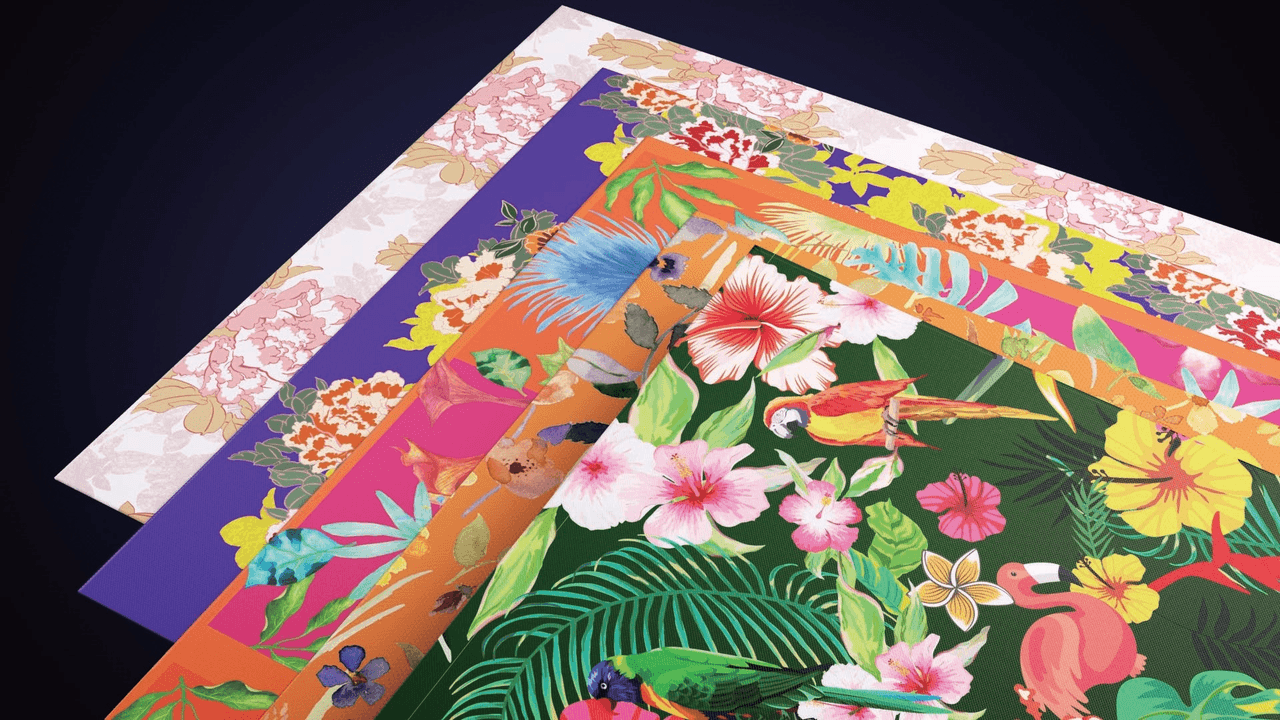
Visitors will be able to see live demonstrations using real fabrics and production applications. Live demonstrations will showcase the Apollo series' integrated single-pass hybrid printing solution, the Iris series' positioning stability and print quality, and applications for both garment and fabric printing.
By integrating equipment, printing processes, inks and fabric compatibility, Hanin will present a comprehensive digital textile printing solution designed around real production requirements.
Visit Hanin from 20 to 24 November 2026 at the National Exhibition and Convention Center (Shanghai), Hall H8.2, Booth C01, to explore the Iris and Apollo series and discuss digital textile printing applications with the Hanin team.